Climate Change Media
Forests and Climate are in the news
New research brings focus back to forests, vegetation in climate debate http://www.crikey.com.au/2011/07/15/new-research-brings-focus-back-to-forests-vegetation-in-climate-debate/
Study casts doubt on forest carbon capture plans
http://www.abc.net.au/news/2011-07-14/tree-planting-carbon-offset/2794426
Climate change media to 13 July 2011
A weekly service of the Climate Centre, Melbourne
To subscribe (one email per week) send blank email to
carbonequityproject-subscribe@topica.com
http://twitter.com/climatecentre
Posted online at
http://www.climateactioncentre.org/mediasummary
Read the archive of weekly media summaries at
http://lists.topica.com/lists/carbonequityproject/read
THIS WEEK…
NOTE: In response to a number of requests, I will now try and include a short overview with each weekly summary. – David
THIS week it’s hard not to be overwhelmed by the carbon package coverage, but I have kept it down to a dull roar. Thankfully some attention is now being given to the Abbott package, including an analysis from the Australia Institute. And Al Gore launches a new project.
AS THE polar north moves towards the summer melt, Arctic sea-ice is tracking at a record low level. The easy-to-read daily-updated satellite image can be found at:
http://nsidc.org/data/seaice_index/images/daily_images/N_stddev_timeseries.png and
http://www.ijis.iarc.uaf.edu/seaice/extent/AMSRE_Sea_Ice_Extent.png
Also significant is research showing a loss in efficiency of the ocean’s carbon uptake.
BUT the most compelling news came from the 4 Degrees or more: Australia in a hot world conference held in Melbourne, which I was fortunate to attend. The opening address was from Prof John Schellnuber, director of Germany’s Potsdam Institute. Rhetorically he asked: “What is the difference between 2 degrees and 4 degrees?” His answer was concise: “The difference is human civilisation”. It is a real step forward that the dreadful realities of a 4-degree world got their first substantial public airing in Australia.
PICKS OF THE WEEK •••••••
••••••• Arctic Death Spiral – Second Lowest June Sea Ice Extent, Lowest June Volume
http://thinkprogress.org/romm/2011/07/08/262576/arctic-death-spiral-sea-ice-volume
Joe Romm, Climate Progress, 8 June 2011
The National Snow and Ice Data Center’s reported this week: Arctic sea ice extent for June 2011 was the second lowest in the satellite data record since 1979, continuing the trend of declining summer ice cover.
AND
Arctic ice melting fast
http://www.abc.net.au/am/content/2011/s3263256.htm
ABC AM, 7 August 2011
Climate scientists are keeping a close eye on the northern summer as the Arctic sea ice melts at a faster rate than ever before. Two-thousand and seven saw Arctic sea ice shrink to a record low level but this year it’s on track to be even worse.
••••••• The real cost of direct action: An analysis of the Coalition’s Direct Action Plan
https://www.tai.org.au/index.php?q=node%2F19&pubid=878&act=display
Richard Denniss and Matt Grudnoff, Australia Institute, July 12, 2011
This analysis finds that the Coalition’s Direct Action Plan will cost far more than is budgeted for and is unlikely to find sufficient greenhouse gas reduction projects in order to reach the Coalition’s emissions reduction target.
••••••• Why are fossil fuel assets Triple-A rated?
http://www.guardian.co.uk/environment/2011/jul/12/fossil-fuels-coal
James Murray, BusinessGreen/Guardian, 12 July 2011
Report suggests valuation of top 200 listed fossil fuel firms is based on ’unburnable’ carbon assets
AND
Why high-carbon investment could be the next sub-prime crisis
http://www.guardian.co.uk/environment/2011/jul/12/high-carbon-investment
Ben Caldecott, Guardian, 12 July 2011
Over-exposure to fossil fuel investments could have even more severe implications than those of the financial crisis
••••••• Al Gore returns with new climate campaign
http://www.guardian.co.uk/environment/2011/jul/12/al-gore-climate-change
Suzanne Goldenberg, Guardian, 12 July 2011
Climate Reality Project aims to expose reality of global warming crisis and kicks off with a 24-hour live streamed event
4 DEGREES CONFERENCE————–
On course to suffer global warming of four degrees
Paddy Manning, Sydney Morning Herald, July 9, 2011
There is only one way to frame the weekend’s carbon tax announcement: a start. Assume Australia hits its very soft target, cutting annual greenhouse gas emissions five per cent by 2020 – and the rest of the world does everything they’ve promised – we are on course to suffer global warming of 4 degrees or more by the end of the century
The end of the world is nigh? It’s just a matter of degrees, says one expert
http://www.theage.com.au/national/the-end-of-the-world-is-nigh-its-just-a-matter-of-degrees-says-one-expert-20110712-1hcad.html
Jo Chandler, The Age, July 13, 2011
Drawing on forecasts of a 4-degree warmer world within a lifetime, Professor Hans Joachin Schellnhuber – one of the world’s most cited and outspoken climate scientists – opened a Melbourne University conference yesterday by painting a bleak picture of an unrecognisable Australia, circa 2100.
A carbon price label is all-important: Schellnhuber
http://www.abc.net.au/lateline/content/2011/s3268037.htm
ABC Lateline, 12 July 2011
Leading climate change expert Professor Hans Joachim Schellnhuber says progress will be much easier now Australia has put a price signal on carbon emissions.
Tougher targets and more focus on renewables would make the lucky country a true leader in tackling climate change.
Hans Joachim Schellnhuber, The Age, July 12, 2011
Australia is a lucky country. Blessed by sunshine, precious minerals and many other resources, it has prospered. As a global presence, the country punches above its weight on many issues, science included. Germans, when asked which country they would choose to emigrate to, say Australia.
Australia at plus 4°C: Not so hot
http://www.climatespectator.com.au/commentary/australia-plus-4-c-not-so-hot
Sophie Vorrath, Climate Spectator, 14 July 2011
Of all the players in Australia’s climate policy debate, farmers might have the right to feel among the most maligned.
Australia faces prospect of being unable to feed itself
http://www.theage.com.au/environment/un-climate-conference/australia-faces-prospect-of-being-unable-to-feed-itself-20110713-1hdyn.htm
Jo Chandler, The Age, July 14, 2011
As the politics of a carbon tax continue to inflame public debate, leading climate scientists gathered in Melbourne yesterday to present their latest projections for Australia if greenhouse emissions continue on their present path.
CARBON PRICE PACKAGE————–
At a glance…
http://www.crikey.com.au/2011/07/10/carbon-tax-gillards-clean-energy-future-at-a-glance
Key points of the carbon price package
Is Australia’s Proposed Carbon Tax Strong Enough to Do Any Good?
http://www.time.com/time/world/article/0,8599,2083303,00.html
Marina Kamenev, Time, 15 July 2011
In August 2010, when Julia Gillard was campaigning in the national election, she made a promise: “There will be no carbon tax under the government I lead,” she said to an Australian television channel.
Good start, but only the beginning of decarbonising the economy
Jo Chandler, SMH, July 11, 2011
Turning around emissions growth this decade and then cutting greenhouse pollution by 80 per cent by 2050 – the target announced by the Gillard government yesterday – would put Australia on the trajectory the world needs to take to avoid the catastrophic consequences of four degrees warming this century, leading climate scientists said yesterday.
Cutting to the chase on emissions
http://www.climatespectator.com.au/commentary/cutting-chase-emissions
Giles Parkinson, Climate Spectator, 11 July 2011
One of the biggest imperatives of Labor’s carbon pricing policy package has been to make the government as small a target as possible. That’s not easy when you’re seeking to transform the economy with the biggest structural change in a generation.
A soft start on carbon
http://www.theage.com.au/opinion/contributors/a-soft-start-on-carbon-20110710-1h8w3.html
Robyn Eckersley and Peter Christoff, The Age, July 11, 2011
Our modest carbon tax is a welcome development, but it is long overdue.
Public transport – collateral damage of our new carbon price
http://theconversation.edu.au/public-transport-collateral-damage-of-our-new-carbon-price-2181
John Stanley, The Conversation, 11 July 2011
Transport accounts for 14% of Australia’s greenhouse gas (GHG) emissions and has one of the fastest emission growth rates. Cutting our national emissions might, therefore, be expected to shine a blowtorch on transport fuels, right?
Carbon price a historic step forward, but political compromise triumphs over scientific necessity
http://climatecodered.blogspot.com/2011/07/carbon-price-historic-step-forward-but.html
Carbon price: Academics’ view
http://www.climatespectator.com.au/commentary/carbon-price-academics-view
What the Greens say
ENERGY&INNOVATION————–
France Becomes First Nation To Ban Fracking
http://www.care2.com/causes/france-becomes-first-nation-to-ban-fracking.html
Gina-Marie Cheeseman, Care2, July 6, 2011
France became the first nation to ban the use of hydraulic fracturing, or fracking in drilling for natural gas and oil on June 30 when French senators voted to ban the practice.
Solar PV price drop mirrors price path of high-tech consumer goods
http://thinkprogress.org/romm/2011/07/06/261550/solar-pv-system-cost-reductions
Stephen Lacey, Climate Progress, July 6, 2011
Clean energy professionals often complain that solar PV receives too much attention compared to other sectors like solar hot water, geothermal and biomass. I’m sympathetic to that sentiment. But I also think the attention is deserved.
Green energy investment hits record global high
http://www.bbc.co.uk/news/science-environment-14030849
Mark Kinverr, BBC News, 7 July 2011
Global investment in renewable energy sources grew by 32% during 2010 to reach a record level of US$211bn (£132bn), a UN study has reported.
When it comes to dishing the dirt, Hazelwood’s up there with the worst
Adam Morton., The Age, July 11, 2011
Hazelwood is often described by environmentalists as Australia’s “dirtiest” power generator. This is arguable – its owner, International Power-GDF Suez says other power stations emit more – but in terms of emissions per unit of power generated it sits at or near the top of tree.
Australian solar’s race to the edge
http://www.climatespectator.com.au/commentary/australian-solars-race-edge
Warwick Johnston, Climate Spectator, 13 July 2011
The Australian solar industry is poised to break through the one gigawatt mark. That makes it a major solar nation, but the industry is about to fall off a cliff.
Green Jobs Reach 2.7 Million: The “Clean Economy” Starts Delivering on its Promise of High-Wage Jobs, Brookings finds
Stephen Lacey, Climate Progress, July 13, 2011
Numerous reports have shown solid growth in the “clean economy” over the years. But what we’re seeing now is that the clean economy is just, well, a normal part of the overall economy — albeit one with higher wages and more value-added.
SCIENCE&IMPACTS————–
Climate Change Reducing Ocean’s Carbon Dioxide Uptake
http://thinkprogress.org/romm/2011/07/12/267277/climate-change-reducing-oceans-carbon-dioxide-uptake
Joe Romm, Climate Progress, 12 July 2011
We now know that as the ocean warms up, its ability to act as a carbon “sink” is diminishing. We are seeing a dangerous, amplifying carbon-cycle feedback.
AND
Ocean carbon sinks feeling the heat
http://edition.cnn.com/2011/WORLD/americas/07/11/atlantic.ocean.carbon.warming/
“Worst food crisis of 21stC” driven by “Worst drought in 60 yrs” in East Africa as CC makes less rain “chronic problem”
Climate Progress, 5 July 2011
“This is the worst food crisis of the 21st Century and we are seriously concerned that large numbers of lives could soon be lost.” That’s from Jane Cocking, Oxfam’s Humanitarian Director, who along with the Save The Children organization, is calling for $144 million in aid to malnourished East Africans.
Researchers push the boundary with high carbon emission scenarios
http://www.eurekalert.org/pub_releases/2011-07/iop-rpt063011.php
Eureka Alert, 4 July 2011
US and Swiss researchers have, for the first time, modeled a climate system with extremely high carbon emissions in an attempt to test the boundaries of the current computer simulation programs that inform us.
Is black carbon affecting the Asian monsoon?
http://www.bbc.co.uk/news/science-environment-14047815
Navin Singh Khadka, BBC News, 8 July 2011
Uncertainties surrounding the timing of the monsoon in recent years are causing anxiety in South Asia. While the debate continues over the role of climate change, scientists have also been looking at the possible role of soot and urban smog pollution in disrupting this weather system.
Italy’s elite are dismayed by vanishing beaches
http://www.guardian.co.uk/world/2011/jul/10/italy-beaches-erosion-climate-change
Tom Kington, The Observer, 10 July 2011
Sand is trucked in to build up a coastline suffering erosion from storms, rising sea levels and development.
Drought Spreads Pain From Florida to Arizona
http://www.nytimes.com/2011/07/12/us/12drought.html
Kim Severson and Kirk Johnson, NYT, 11 July 2011
The heat and the drought are so bad in this southwest corner of Georgia that hogs can barely eat. Corn, a lucrative crop with a notorious thirst, is burning up in fields. Cotton plants are too weak to punch through soil so dry it might as well be pavement.
Is Sea-Level Rise Accelerating?
http://www.realclimate.org/index.php/archives/2011/07/is-sea-level-rise-accelerating/
Real Climate, 12 July 2011
A few months ago a paper by Jim Houston and Bob Dean in the Journal of Coastal Research (JCR) cast doubt on whether global sea level rise has accelerated over the past century or so. As things go these days, ‘climate sceptics’ websites immediately heralded this as a “bombshell”. A rebuttal by myself and Martin Vermeer has now been published in JCR.
Media Release for June 5th Rally
The walk will begin at 1.30 on Sunday, 5 June at Regatta Point, near the bridge.
CRUNCH TIME ON CLIMATE CHANGE
31.5.11
Climate and Environment Groups Join Forces for Climate Action
With the Federal Government’s Multi Party Climate Change Committee moving towards making critical decisions on Australia’s climate change policies, Canberra’s climate and environment organizations are banding together to send a powerful message to our politicians.
According to key organizers Geoff Lazarus and Prof Bob Douglas, “a carbon tax and a few other modest measures aren’t enough in themselves to transform our economy to being based on renewable energy.”
“We are saying to the Federal Parliament, we must have a raft of strong measures including base load solar power stations, expansion of wind power, a feed in tariff and new land management practices as a matter of great urgency.”
“Expanding our fledgling renewable energy industries has the potential to create thousands of new jobs.”
“Australia, along with other major polluters, must play its role in reducing carbon levels, particularly as we have the highest per person pollution levels in the world.”
“With extreme weather getting worse and worse due to global warming impacts on the world’s climate, we can’t afford to put off taking real climate action according to leading climate scientists.”
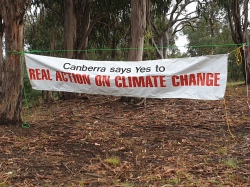
Come rain or shine on Sunday June 5, a huge crowd will walk across Commonwealth Bridge to Parliament House from Regatta Point, to tell our parliamentarians CANBERRA SAYS YES TO REAL CLIMATE ACTION NOW!
The CANBERRA SAFE CLIMATE ALLIANCE, includes Climate Action Canberra, Greenpeace, SEE-Change ACT, Conservation Council ACT Region, ACT Environment Centre, Canberra Loves 40%, Climate Active Australia, ANU Environment Collective, Canberra Pedestrian Forum, Climate Whistleblowers, AYCC and Healthy Soils Australia,.
The walk will begin at 1.30 on Sunday, 5 June at Regatta Point, near the bridge.
There will be live music, kid’s activities, and informed and inspirational talks to be followed by a march on Parliament. Speakers will include John Hewson(former leader of the Federal Parliamentary Liberal Party), Richard Denniss(Australia Institute), Bishop Pat Power, Linsey Cole(AYCC), Lin Hatfield Dodds(Uniting Care), Gosta Lynga(former Swedish member of Parliament) and Phoebe Howe from Canberra Loves 40%.
For further information contact Geoff Lazarus, 0419 369 206 or Prof Bob Douglas, 0409 233 138
Write letter to the Editors. Get on talk back radio.
Contact details for letters to the editor & talk back radio are below.
Points you might like to consider in your letter:
- Climate scientists say human activity is the major cause of global warming,
- We face a climate emergency with ever increasing extreme weather events and need a plan to take us to a safe climate,
- A price on carbon will… reduce coal and oil usage and therefore emissions that are causing the planet to heat up,
- Our politicians must support a high price on carbon and other strong measures. This could be a big step forward for Australia and create great opportunities for economic development and thousands of new jobs,
- Ordinary Australians should receive compensation for a price on carbon depending on their financial circumstances,
- Tony Abbott’s confusion on climate change and flip-flops on a price on carbon creates industry and community uncertainty.
Remember keep it short and to the point – if it’s less than 150 words, it’s far more likely to be published! Also make sure you put your contact details into your email – they will not be published but they are vital to allow the paper contact you and confirm your letter.
- Adelaide Advertiser: submit letters at www.news.com.au/adelaidenow/news/opinion/sendletter
- The Age: email letters to letters@theage.com.au
- The Australian: email letters to letters@theaustralian.com.au
- Australian Financial Review: email letters to edletters@afr.com.au
- Canberra Times: email letters to letters.editor@canberratimes.com.au
- The Courier Mail: submit letters at www.news.com.au/couriermail/editorial/letter
- The Daily Telegraph: email letters to letters@dailytelegraph.com.au
- The Herald Sun: submit letters at www.news.com.au/heraldsun/editorial/letter
- Hobart Mercury: submit letters at www.themercury.com.au/opinion/letter-to-the-editor-submit.html
- Sydney Morning Herald: email letters to letters@smh.com.au
- The West Australian: email letters to letters@wanews.com.au
This will be a hot topic in the days and weeks to come.
You might also like to take part in Talkback radio discussion as it happens.
- Australia-wide ABC NewsRadio – 13 9994
- ABC Radio National – (02) 8333 2821
- ACT ABC Canberra (666AM) – 1300 681 666
- NSW ABC Newcastle (1233AM) – 1300 233 222
- ABC Sydney (702AM) – 1300 222 702
- 2GB (873AM) – 131 873
- 2UE (954AM) – (02) 9930 9954
- 2SER (107.3FM) – (02) 9514 9514
- 2SM (1269AM) – 13 12 69
- FBI (94.5FM) – (02) 8332 2999
- vega (95.3FM) – 13 25 10
- 2NUR (103.7FM) – (02) 4921 5000
- SA ABC Adelaide (891AM) – 1300 222 891
- FiveAA (1395AM) – (08) 8223 0000
- Fresh (92.7FM) – 1300 7 FRESH
- Radio Adelaide (101.5FM) – (08) 8303 5000
- TAS ABC Hobart (936AM) – 1300 222 936
- 7HO (101.7FM) – (03) 6216 1017
- NT ABC Alice Springs (783AM) – 1300 019 783
- ABC Darwin (105.7FM) – 1300 057 222
- QLD ABC Brisbane (612AM) – 1300 222 612
- WA 6PR (882AM) – (08) 9221 1882
- ABC Perth (720AM) – 1300 222 720
- RTR (92.1FM) – (08) 9260 9210
- VIC 3AW (693AM) – (03) 9690 0693
- 3CR (855AM) – (03) 9419 0155
- ABC Melbourne (774AM) – 1300 222 774
- JOY (94.9FM) – (03) 9699 2949
- PBS (106.7FM) – (03) 8415 1067
- SYN – (03) 9925 9907
- RRR (102.7FM) – (03) 9388 1027
Join the CLIMATE CALLOUT: Phone the Climate Committee.
The Climate Committee is expected to be making announcements about carbon pricing and other matters soon.
An announcement of a low price on Carbon of around $20 per tonne is anticipated. The big polluters will disingenuously claim it will cost lots of jobs.
Feel free to use this messaging in media statements.
Join the “Climate Callout” - phone Climate Committee members .
1. Put a high price on carbon now -and phase in $40 – $50 per tonne”
3. End all fossil fuel subsidies ($8.6 Billion per annum)
4. Support solar, wind and geo-thermal power industries and new clean energy jobs
5. Support communities impacted by phasing out of coal based industries.
6. Create a new Government authority to steer a transition to a renewable energy based economy
7. No compensation to the big polluters
The phone numbers of politicians to call are listed below. Most likely you will end up talking to a staff member.
PM Julie Gillard Tel: (02) 6277 7700 Fax: (02) 6273 4100 Internet: http://www.pm.gov.au/contact-your-pm
Deputy PM Wayne Swan Tel: (02) 6277 7340 Fax: (02) 6273 3420 E-mail: Wayne.Swan.MP@aph.gov.au
Climate Change Minister Greg Combet Tel: (02) 6277 7920 Fax: (02) 6273 7330 E-mail: Greg.Combet.MP@aph.gov.au
Tony Windsor MP Tel: (02) 6277 4722 Fax: (02) 6277 8545 E-mail: Tony.Windsor.MP@aph.gov.au
Senator Bob Brown Tel:(02) 6277 3170 Fax: (02) 6277 3185 Email: senator.bob.brown@aph.gov.au
Climate Action Canberra, Geoff Lazarus 0419 369 206,
Rebecca Horridge 0406 375 401
Climate Action Canberra Media Release 16.2.2011
Low carbon price means high cost for global warming
Climate Action Canberra (CAC) today called on the Government’s Climate Committee to take immediate action on Friday to define a pathway to a safe climate for Australia.
According CAC spokesperson, Geoff Lazarus, “the key to Australia playing its part in emission reductions and rapid development of renewable energy industries is to set a price on carbon with a schedule of price increases to have coal-based electricity phased out within ten years.”
“Instead of a confusing message about energy choices, the combination of carbon price and regulations needs to provide a compelling reason for transition.”
“We must set a phased in price of at least $40-50 per tonne that will drive investment towards a new clean renewable energy economy.”
“The Government’s low price will lock Australia into continuing fossil fuel usage that the NASA climate science chief James Hansen says is a ‘recipe for disaster’.”
“Having a safe climate for current and future generations requires taking action now commensurate with the scale of the problem.”
“It can’t be a compromise with business groups concerned about protecting their profits.”
“According to the NAB Bank, the total cost of recent floods alone could shave off 1.5% of our GDP in the March quarter.”
“If we don’t act now we will be subjected to even more extreme weather events that will, over time, impose a greater cost than the 2 to 3% of GDP per year required to take us to a clean, renewable energy economy.”
“An appropriate price on carbon and appropriate use of its proceeds could see the creation of many thousands of renewable energy jobs and proper support for communities impacted by change.”
FOR FURTHER INFORMATION CONTACT: Geoff Lazarus, 0419 369 206
Facing the Climate Emergency
The era of procrastination, of half-measures, of soothing and baffling expedients, of delays, is coming to its close. In its place we are entering a period of consequences. – Winston Churchill

We face a climate emergency
The climate is changing faster than we thought. What we believed would happen in a hundred years is happening now. It’s getting hotter, the ice caps are melting, the oceans are rising, bushfires are bigger, and crops are failing. A climate crisis threatening hundreds of millions of lives faces us all, and we have to start treating it as an emergency!
For years our cars have run on petrol and our electricity has come from burning coal. Climate-changing gases have been pumped into the air. If we continue to release these gases for much longer it will soon be impossible to stop the climate from changing dramatically.
Climate change can be daunting, but like any emergency we have to deal with it. We need to respond to this emergency the same way we would a bushfire or if someone was having a heart attack – with action.
If we ignore climate change now, we will be unable to ignore the damage it causes in the near future – and the survivors will ask why we didn’t act when we still could.

We need an emergency response
Australians know that climate change is a real problem and many of us are taking personal steps to stop it – such as using less electricity in the home. But this only solves a small part of the problem. We need businesses and government to act – but they aren’t. Money needs to be invested into cleaner energy and transport solutions, not large polluting industries.
We need to quickly change how we generate power, produce food, travel, and organise our economy. Responding to this emergency will bring change and create job opportunities through new industries and different farming practises.
The ‘put jobs before the climate’ argument is completely misleading and hollow. It’s a lot like arguing that a fire-fighter should let a house burn so that builders will have work.
In working together to solve this crisis, we will also strengthen our communities.
Humankind has shown that we can rise to meet urgent challenges when needed. In World War Two car factories became tank factories, millions of civilians were trained to be soldiers, and the world’s largest consumer economy (the USA) became the largest military economy within one year. Today, instead of tanks and soldiers we need clean energy and engineers; are we able to do what we did 65 years ago to save humanity?

The climate movement needs you
An emergency response is possible, but it’s far from certain. Polluting industries pay hundreds of professional lobbyists to spread doubt about climate science – just like tobacco companies did about the medical effects of smoking. And politicians are still able to win votes by talking ‘green’, but acting dirty.
It’s becoming increasingly clear that it’s up to individuals to change this. Thousands of people across Australia, from every walk of life, have realised that they need to do something. But time is short, so we have to face facts about what is the most effective ‘something’ for people to do.
Climate change will not be avoided through individuals living green lifestyles or buying green products, but by individuals uniting to transform their societies. Living in the only climate-friendly house in your street, in a city built around cars, is not the solution.
As long as millions of tonnes of oil and coal are still being burnt, we are simply standing aside while politics-as-usual and business-as-usual destroys our Earth. And unfortunately, it’s the only one we’ve got.
Accepting that climate change is real is no longer enough. To judge between real solutions and the fibs of politicians, we must understand the urgency and size of the problem. We cannot ignore or negotiate with the laws of physics and chemistry, and we need to know when our leaders are trying to do just that.
To survive this emergency we must change the way we do things. To succeed we will need to find the courage hidden within ourselves. We will need to argue with our friends, go to a protest instead of to a movie, and put our reputations on the line. Some of us – in the tradition of Gandhi, Mandela and King – may risk even more.
These are truths that don’t fit easily with the way we’ve always done things – but we should not disregard them, for we now enter an age of consequences. There is hope, and more than hope, in the hundreds of climate action groups that now exist throughout Australia. If you haven’t joined one yet, now is the time.

Climate change is too much of a hot potato for our leaders
by Geoff Lazarus
The floods show us that Gillard and Bligh lack conviction on tackling global warming. With the weather disaster being played out in eastern Australia, it’s pleasing to see our political leaders giving good leadership to the authorities and communities dealing with the tragic loss of life and property impacting on thousands of Australians. Queensland Premier Anna Bligh’s two-hourly press conferences were informative and well conducted. And apart from the rather silly offering to some West Australians of lesser flood relief amounts than for Queenslanders, Prime Minister Julia Gillard has become a strong leadership voice supporting flood-stricken communities in three states.
Less pleasing has been their failure, along with Opposition Leader Tony Abbott, to properly explain the atmospheric and oceanic factors influencing our weather which is putting people’s lives and property at risk and will continue to do so with greater intensity over coming decades. Gillard disappointed those of us who understand the dynamics of global warming when asked indirectly and directly on ABC radio about its relationship to current weather events and whether we have to plan for future disasters. She avoided answering the questions.
What she should have said is that our nation has always been periodically beset by floods and droughts but due to global warming these events are even more likely to occur and with greater intensity.
Tying down the connection between eastern Australian flooding and global warming is not a straight forward matter. To what extent it’s caused by natural climate variability on the one hand, and global warming on the other, can’t be clearly established at this point. But while we can’t say with absolute certainty that individual events can be attributed to climate change, the weather extremes are in keeping with the views and predictions of climate scientists.
Melbourne University climate science professor David Karoly said recently the wild extremes being experienced by the continent were consistent with scientists’ forecasts of more flooding associated with increased heavy rain and more droughts as a result of high temperatures and more evaporation. Karoly says the present heavy rainfall is being caused by our experiencing of possibly the strongest La Nina in recorded history as well as record-high ocean temperatures in northern Australia, which means more moisture evaporating into the atmosphere which in turn means lots of heavy rain.
The record high ocean and atmospheric temperatures are, of course, being caused by global warming factors. Back in 2004, the CSIRO predicted that climate change would lead to more intense rainfall globally, and that results from a computer model focusing on regional Australia suggested small areas would receive much more extreme rainfall. Each year extreme rainfall events cause significant damage as a result of flooding in the highly urbanised regions along Australia’s eastern coastline where population is increasing. CSIRO says this will become all too apparent in future decades.
Last year, the scientific advisory group to the Queensland Government’s inland flooding study advised ‘‘an increase in rainfall intensity is likely’’ and ‘‘the available scientific literature indicates this increased rainfall intensity to be in the range of 3 to 10 per cent per degree of global warming.’’And according to the CSIRO, a 26 per cent increase in flooding leads to a 60 per cent increase in damage costs and with projected increases in the intensity and frequency of extreme precipitation events, the community’s exposure to extreme rainfall events is growing rapidly.
The CSIRO and the advisory group are providing clear warnings on what will happen in future decades and Gillard and Bligh should be articulating a perspective that acknowledges what climate science is telling us. Will Bligh factor this into future planning decisions in the recovery period? Will she ensure that businesses and residents are fully informed of the probability of this type of event repeating itself? Not likely because this could lead to questions about her rapidly expanding and large coal industry.
The irony of global warming impacts on Queensland is the fact that it’s also Australia’s leading contributor to global CO2 emissions. As for Gillard, isn’t this the appropriate time for the Government to properly explain what global warming is and how it’s going to have a greater and greater impact unless the top 22 polluting nations, that include Australia, reduce their emissions by 80 to 100 per cent over the next 10 years?
For all the talk by our leading politicians about the seriousness of climate change, there continues to be little sign of the strong leadership required to have Australia play its role in averting a global catastrophe.
The next test for the Government will be whether it’s prepared to put in place a price on carbon through a carbon tax and regulations substantial enough to drive the transformation to a renewable,energy-based economy. This means scrapping the 12 coal-based power stations proposed for various states. Judging by our politicians’ recent performances, it’s hard to be optimistic about the future wellbeing of the nation.
(this article was published in the Canberra Times on Jan 22nd)
■ Geoff Lazarus is a spokesperson for Climate Action Canberra.
News from September 2010
OPENING OF PARLIAMENT 2010
As all the members of parliament assembled in front of Parliament House for the opening of the new coalition government, they could not fail to notice the 10m banner screaming: CLIMATE EMERGENCY. [350]
Why were we there, straining with the banner, in the wind? This parliament has been elected by the Australian people with the expectation they will work at emergency speed to protect our ecosystems and economies from climate change. Co2 emissions are still rising. Although talk is moving in the right direction we are asking our leaders to roll up their sleeves and come to grips with averting dangerous climate change. We wish them all the best in this mission.

A new event from Climate Action Canberra and the ANU Environment Collective
COAL and CLIMATE CHANGE:
Forum and discussion
Australia as the world’s largest exporter of coal is supplying the world’s coal addiction. Our coal exports are projected to double over the coming decades. Coal mining also conflicts with land uses like conservation and food production, and has large health impacts. Hear from this switched on panel and then join the discussion about the expansion of coal in Australia and what strategies we should take to do something about it.
The Panel
- Jeremy Tager: Greenpeace political advisor
- Paola Cassoni: Co-owner of Bimblebox Nature Refuge in Queensland, threatened by Clive Palmer’s coal development.
- Walter Jehne: from Climate Action Canberra talking on ‘Our imperative and options to safely draw down atmospheric CO2 levels and secure our safe climate’
When: Monday October 11th, 6.30-8.00pm
Where: Manning Clark Centre, Theatre 6, Australian National University.
See the online ANU campus map [grid reference26a] to find Manning Clark Centre
Coin Donation For more details: Rebecca Horridge 0406375401
Climate Action Canberra is launching a poster campaign as part of the Global Work Party event on 10/10/10 . Thousands of people will take action towards reaching 350ppm on the tenth of October. We will be putting up posters at shopping centres and on community notice boards. The posters tell the meaning of the number 350 parts per million….the most important number in the world…the concentration of CO2 that allows for a safe climate. . We will be sending them to you by email but if you would like paper copies from us them contact climateactioncanberra@hushmail.com
Look out for them around Canberra.
Campaigns
Canberra ♥ 40%
News from Phoebe on the Love 40% campaign
The future for Love 40% and climate change action in the ACT
Over the coming weeks, the Canberra Loves 40% campaign will meet to discuss and finaliseour next steps, and we had a big surprise in store. We were joined by a representative from the Legislative Assembly who told us the next big decisions coming up that will influence how we will get to the 40% target. The legislation around the 40% target provides us with a strong guiding ideal for action in the ACT, it now requires strong implementation policies to make sure it can be met. The two big concerns that the community need to keep an eye on are the Energy Policy, and the creation of the Minister’s Advisory Council on Climate Change.
The first concern is that it’s happening fast. In the next month, the Government will be tabling its Energy Policy to the Assembly. Many of us in the ACT will be familiar with this document, having entered submissions. However, the Government is using this document as our guiding framework for the entire strategy for how we will achieve the 40% target. It will outline the key areas that the Government will focus on. These look to be renewable energy generation and some efforts at building energy efficiency. However, the Energy Policy was created before the 40% target was secured- we wonder how this old policy covers the new and transformative direction for the ACT.
The Government is also closing this policy to further consultation; so we will be locked in. The policy that the Government constructs to get us to 40% must be strong. This target is going to mean big debates within our community, about urban infill, public transport, planning. It will mean bringing very hot debates into the arena about what we want for our city, and what is best for residents, communities and small businesses, not just the major industries like building. We need to know that the Government is forming policy that will allow us to properly address these questions, rather than rushing through poor policies that may simply not work at reducing our emissions. Love 40% will be focussing on the Energy Policy over the next three months, creating our own public consultation.
We are planning another large public forum to let our representatives know that we are aware and involved in their policy choices, and we need them to be sufficient. This energy policy has the potential to be a fantastic driver of real change in the ACT, we need to make sure it fulfils that potential.
The Minister’s advisory council will also be set up as soon as the Climate Change Legislation is formally passed; this could be next week. This council also has fantastic potential; community, business and science representatives will advise the Minister directly on policy ideas and the impacts on our community. However, it is also a forum that could favour industry voices. We need to be certain that the interests of the community are being heard, and that all sectors are bringing creative, innovative ideas that will create a modern and beautiful city directly to the Minister.
These decisions and policies will direct heavily the pace and direction of action to combat climate change and transform the ACT over the next ten years. This will affect the work of all of us, especially community groups. This is a great time for all of us to be taking notice, and letting our Government know the best way to get to 40%. Canberra Loves 40% will remain as a partner to all groups working toward sustainability and taking on climate change, and we’d like to work with you.
Best wishes,
Phoebe Howe info at love40percent.org See http://love40percent.org for all background to the Canberra ♥ 40%campaign
Vision 2020
SEE-Change has been successful in receiving ACT Government funding to run a series of competitions in 2011 that will encourage kids of all ages to develop their own vision for Canberra in the next ten years.
We are hopeful that a SEE-Change team of volunteers will help undertake detailed planning for the project during this second half of 2010 including developing three separate “road shows” for presentation by recent school leavers at ACT school assemblies during 2011.
Recent school leavers, parents, grandparents and retired and current school and college teachers particularly welcome to volunteer for this effort. If you would like to be involved in this exciting project and want to learn more please contact Naomi Wynd, Executive Officer See-Change.
Email: office at see-change.org.au
Telephone: 02 6162 2320